CAW On-Chain Observation Report
— A Pattern Beyond “Play”: The Subtle Rhythm Behind the 666,666 Burns —
⸻
Prologue: What Seemed Like Just Another Burn
At first glance, it looked ordinary.
A small-scale burn of 666,666 CAW sent to the familiar null address
0xdead000000000000000042069420694206942069 —
the kind of transaction often dismissed as a casual gesture from an enthusiastic holder.
Many assumed it was nothing more than a playful act within the community.
The amount was minor, the address was standard, and such burns had appeared randomly before.
Yet, as more transactions appeared, something about this series began to stand out.
The amount was always identical.
The destination never changed.
And the timing between each burn began to form a rhythm — a recurring pattern,
executed by several different wallets in near-perfect intervals.
What initially looked like spontaneous behavior started to resemble
a quiet, coordinated pulse —
a system testing its own heartbeat.
⸻
- Multiple Addresses, One Rhythm
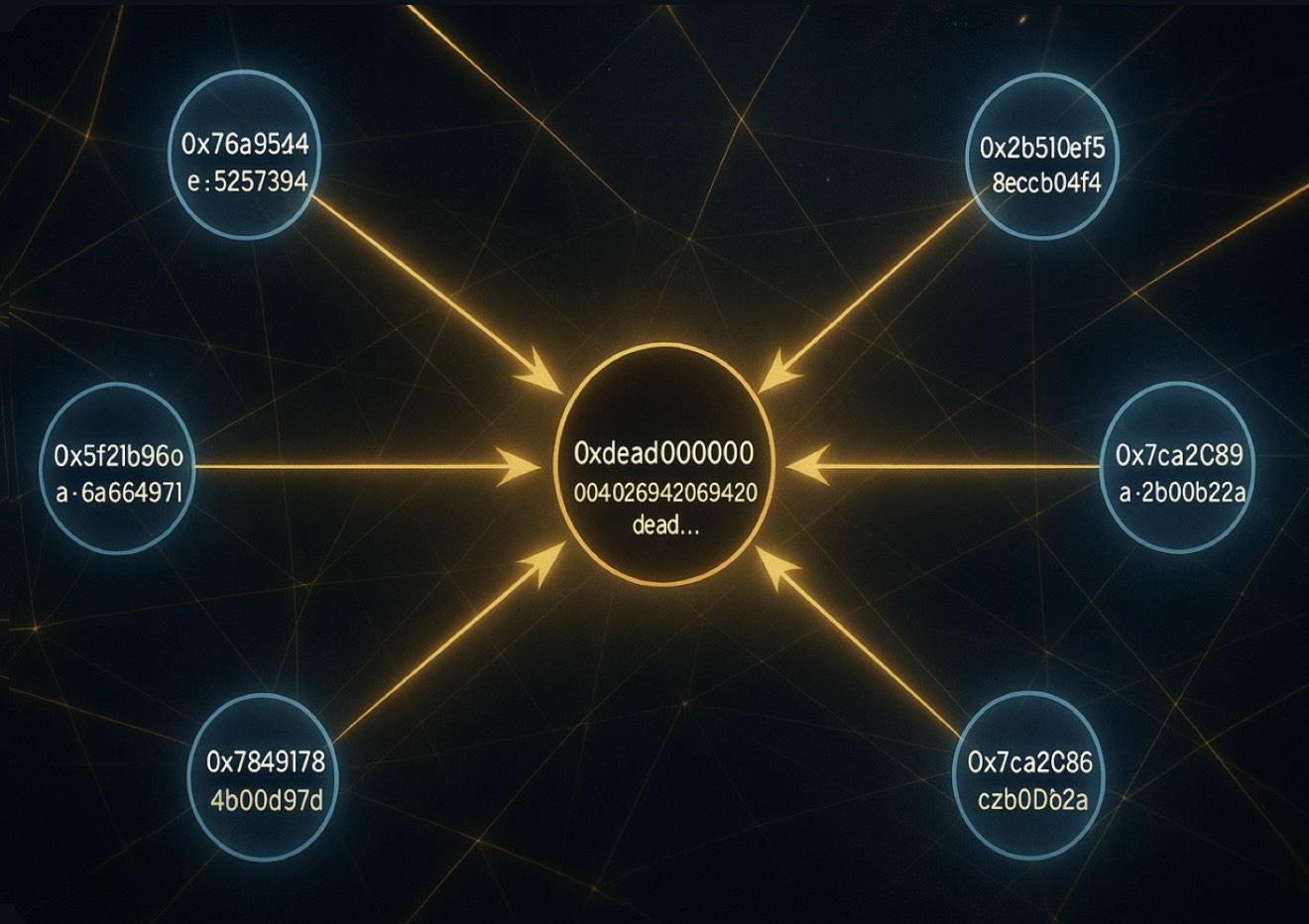
The on-chain data reveals a surprisingly consistent signature across several addresses.
Each of them repeatedly sent exactly 666,666 CAW to the same null address,
often within 7- to 10-day intervals.
The most frequently active address, 0x0987d6F05FA4Cc4…,
has carried out this burn pattern for weeks with precise regularity.
Another, 0x9F6042AE859E8145…, performs a more complex route —
moving funds through exchanges such as MEXC and Uniswap before executing the burn,
suggesting a link between liquidity movement and the final transaction.
The older node 0x7C00A14Cd577a3d3…,
which dates back to CAW’s early days, still performs small burns periodically.
And notably, 0x76A795D4C4E540f3…, which had been dormant for over 527 days,
suddenly came back online in October 2025 to perform the exact same 666,666-CAW burn.
A fifth address, 0x2b5108ef5F13d469…,
has maintained a steady 4- to 7-day burn cycle since mid-October.
The repetition across these addresses —
same amount, same destination, similar timing, same routing patterns —
appears too synchronized to be random.
Whether intentional or coincidental, the result resembles a distributed sequence,
as if several independent entities were responding to a shared internal signal.
⸻
- The Return of a Long-Silent Node
Among these movements, the reactivation of 0x76A795D4… stands out the most.
Linked to CAW’s early liquidity operations,
this wallet had shown no activity for well over a year.
Then, suddenly — in the same week as other active burn nodes —
it sent 666,666 CAW to the null address,
aligning perfectly with the same pattern observed elsewhere.
It’s difficult to say what triggered this.
It could be coincidence, or the result of an automated process coming back online.
Still, the timing overlap between several previously unconnected addresses
gives the impression that something within the network may have been quietly re-engaged.
⸻
- A Layered Network Emerges
When viewed collectively, these addresses seem to form a layered structure.
At the top, 0x7C00A14C… functions like a legacy node —
an observer that has remained active since the earliest blocks.
Beneath it, 0x9F6042AE… acts as a bridge,
shifting assets between DEX and CEX environments before completing the burn.
The 0x0987d6F0… wallet performs as a periodic “trigger node,”
while 0x76A7… and 0x2b51… appear to serve as supporting nodes,
reinforcing the rhythm from opposite sides.
These wallets do not transact directly with each other,
yet their behaviors line up in timing and structure.
It’s as if they are following the same unseen schedule —
a distributed synchronization rather than a centralized command.
Whether this is the result of human coordination or algorithmic automation remains unclear.
But the symmetry itself is difficult to ignore.
- The Rhythm of the Burns
Across roughly forty days of blockchain data,
a distinct wave pattern becomes visible.
•41 days ago: 0x0987d6F0… initiated a burn.
•30 days ago: 0x2b51… followed.
•12 days ago: 0x7C00… executed a smaller burn.
•7 days ago: 0x0987… and 0x76A7… acted in the same block window.
•4 days ago: 0x2b51… repeated its pattern.
The rhythm is clear,
and the repetition — both in value and destination —
feels less like random movement and more like a timed pulse,
a heartbeat echoing through the network.
⸻
- Technical Interpretations
From a technical point of view, several hypotheses emerge.
One possibility is cross-chain synchronization testing —
perhaps using LayerZero-style message protocols or OFT (Omnichain Fungible Token) frameworks.
In such systems, small, repetitive burns could be used to verify bridge integrity or state alignment.
Another possibility is the reactivation of an autonomous governance or monitoring script.
Since CAW’s contract was renounced, there is no central authority to trigger such actions manually.
If early infrastructure scripts were coded to self-check the network periodically,
these burns might simply represent the reawakening of those long-dormant processes.
There is no way to confirm either hypothesis yet.
Still, the consistent timing and identical parameters suggest
this pattern may not be entirely coincidental.
It might not be proof of coordination —
but it does indicate a degree of structure beneath the surface.
⸻
- What to Watch Next
If this sequence continues in the coming days,
and especially if multiple burn nodes act again within the same short window,
it could signal the completion of another synchronization cycle.
Key factors to monitor include:
•Frequency of burns to the null address (0xdead…069).
•Activity of 0x9F6042AE…, which serves as the exchange bridge.
•Reactivation of dormant nodes, like 0x76A7…, that might return online.
If all three occur within a short time frame,
it may imply an internal network alignment process —
though whether that leads to further on-chain events remains to be seen.
⸻
Epilogue: The Meaning of a Quiet Pulse
At first, this seemed like a trivial pattern —
a few holders burning coins for fun.
But as the pattern deepens,
it feels less like noise and more like a subtle form of communication.
A burn, after all, is not only destruction.
It can also be a signal.
We don’t yet know whether this rhythm points to a larger reconfiguration
or simply reflects a long-running automated cycle.
Still, every repetition seems to confirm one thing:
the CAW network is not silent.
Something within it continues to move —
quietly, methodically, perhaps even deliberately.
And while its purpose remains hidden,
its rhythm is impossible to ignore.
⸻
(All observations in this report are based solely on verifiable, on-chain transactions recorded on Etherscan as of October 24, 2025.
Addresses referenced: 0x0987d6F0…, 0x9F6042AE…, 0x7C00A14C…, 0x76A795D4…, 0x2b5108ef….
This analysis is purely observational and does not claim definitive conclusions.)
Cawing soon!