“Humanity Is Finished If We Don’t Go to Mars”
Why Elon Musk Seriously Says
“Humanity Is Finished If We Don’t Go to Mars”
— The 4.5 Billion-Year Perspective on Civilization Backup —
Elon Musk often repeats a statement that sounds extreme:
“Humanity must become multi-planetary.”
“This is not about dreams. It’s about survival.”
Many people dismiss this as science fiction optimism.
But Musk is not thinking in years or decades.
He is thinking in geological time.
⸻
Earth Is 4.5 Billion Years Old. Civilization Is a Blink.
Let’s put the numbers on the table:
•Earth formed: ~4.5 billion years ago
•Life moved onto land: ~500 million years ago
•Dinosaurs went extinct: ~65 million years ago
•Written human language began: ~5,000 years ago
Human civilization represents less than 0.0001% of Earth’s history.
On a planetary scale, our entire civilization is equivalent to one blink of an eye.
What we call “modern society” is not ancient.
It is practically yesterday.
⸻
Something Unprecedented Is Happening Right Now
During this tiny window of time, something has happened for the first time in history:
An intelligent species has gained the technological ability to leave its home planet.
This is not one breakthrough.
It is the convergence of many:
•Reusable rockets
•AI-assisted engineering
•Automated manufacturing
•Large-scale space logistics
•Orbital infrastructure
All of these technologies became viable at the same time — only now.
This is what Musk is watching.
⸻
“This Window Will Not Stay Open Forever”
Civilization may feel stable, but it is fragile.
If any of the following occur:
•Nuclear conflict
•AI catastrophe
•Global pandemics
•Asteroid impacts
•Climate collapse
Human technological progress could collapse rapidly.
And once civilization regresses, it may take tens of thousands of years to return to a level capable of space travel — if it ever happens again.
We are currently in a rare moment where:
•Space technology exists
•Civilization infrastructure still functions
This overlap is extremely narrow.
Musk calls this the civilization window.
⸻
SpaceX Is Not a Rocket Company
Here is the core misunderstanding.
SpaceX is not building rockets.
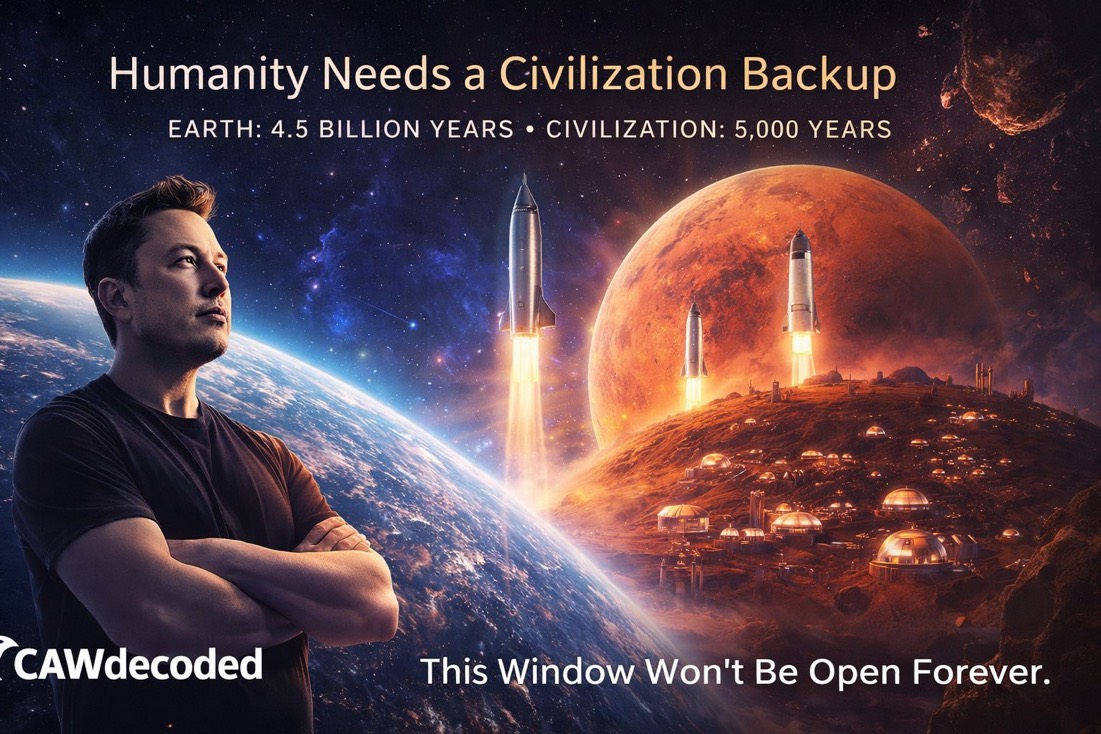
It is building a civilization backup system.
•Lunar infrastructure
•Martian settlements
•Multi-planetary redundancy
If Earth fails, humanity should not fail with it.
This is the real mission.
⸻
Mars Is Not a Dream. It Is Insurance.
Mars colonization is not science fiction.
It is civilization insurance.
Musk does not approach this emotionally.
He approaches it mathematically.
Starship is designed for:
•Massive payload capacity
•Full reusability
•High launch frequency
The calculations are logistical:
•How many launches per year
•How many tons of material
•How many settlers per phase
•How many years to reach self-sufficiency
The discussion is no longer:
“Is this possible?”
It has become:
“How fast can we scale it?”
⸻
This Is Not Romantic Idealism
Musk is not chasing fantasy.
He is acting as a civilization engineer.
Life took 4.5 billion years to emerge on Earth.
Keeping it trapped on a single fragile planet is an unnecessary risk.
This is not philosophy.
It is infrastructure strategy.
⸻
“This May Be Our Only Chance”
That is why Musk says:
This may be the only chance we get.
From a historical perspective, he is likely correct.
The current moment is extraordinarily rare.
And this idea strongly overlaps with CAW’s core philosophy:
•Distributed systems
•Redundancy over centralization
•Survival through decentralization
Not one planet.
Not one system.
Not one point of failure.
⸻
CAWdecoded Perspective
Civilizations do not survive by strength alone.
They survive by distributed architecture.
What Musk is building in space
and what CAW envisions in digital economic infrastructure
follow the same structural principle:
Decentralize risk.
Eliminate single points of collapse.
Design for continuity.
HODL!