What If Elon Musk Never Uses CAW? — The Empire Without Freedom
Elon Musk’s ambition has never been limited to business or innovation.
His true objective is far more profound — to create the operating system of civilization itself, a network that unites energy, intelligence, communication, and the economy across both Earth and Mars.
But what happens if Elon pursues this dream without CAW (A Hunter’s Dream) — the only decentralized protocol that reflects freedom, anonymity, and equality in code form?
The answer may surprise you.
Without CAW, his world would function perfectly, yet lack the very freedom it was meant to protect.
⸻
- Elon’s Vision: Building the Operating System of Civilization
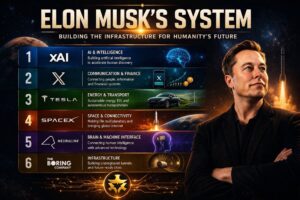
Every one of Musk’s ventures represents a piece of his grand design.
SpaceX grants humanity the freedom to move beyond Earth.
Tesla enables energy independence.
Neuralink merges the human mind with information itself.
Starlink liberates communication from physical borders.
X, formerly Twitter, stands for ideological and social freedom.
And xAI, through Grok, symbolizes the freedom of intelligence.
Together, these projects form the skeleton of Macrohard, a universal network where humans, AI, and machines coexist seamlessly.
It is not a single company — it is the infrastructure of a new civilization.
⸻
- Theoretically, Elon Could Build It Without CAW
Technically, Elon already has the tools to replicate what CAW represents.
X and Bluesky could provide the social layer.
xAI and Starlink could create a private omnichain communication grid.
Grok AI could serve as the decentralized moderator of truth.
X Payments and X Money could establish an internal token economy.
And the Macrohard API could enable an ecosystem of extensions and plug-ins.
In theory, these components could simulate the architecture of CAW.
Elon could build a self-contained, all-powerful digital universe — one where everything connects through his ecosystem alone.
But this version of reality would be controlled, not free.
⸻
- The Illusion of Freedom in a Controlled Empire
CAW’s greatest power lies in its paradox: because no one owns it, everyone can trust it.
It is not designed to serve authority — it is designed to dissolve it.
If Elon reconstructs CAW’s structure within X, the result becomes Elon’s empire rather than a human network.
It may look decentralized, but at its core, every gate, rule, and permission would depend on a single corporate entity.
This mirrors what happened with the internet.
In its early days, it promised freedom and openness.
But over time, that freedom was absorbed by giants — Google, Meta, and Amazon — each reshaping the web into their own walled garden.
Without CAW, Elon risks creating the same paradox: a network that connects everyone yet belongs to no one but him.
- The Limits of a CAW-less Future
The first limitation is philosophical.
Without CAW, freedom becomes conditional. It depends on Elon’s personal ethics and decisions.
In a truly decentralized system, trust emerges from mathematics, not authority.
The second limitation is technical.
CAW’s LayerZero integration allows value and identity to move fluidly across blockchains and ecosystems.
A private protocol under X could not achieve the same openness or compatibility with global networks.
The third limitation is political.
CAW is stateless — it cannot be controlled by any government or legal system.
X, however, is an American company. It remains bound by the very national structures that CAW was designed to transcend.
By excluding CAW, Elon would be choosing to fight for global freedom within the cage of regulation.
⸻
- Why Elon Needs CAW — Not to Own It, but to Use It
CAW is not a competitor to Elon’s vision — it is the missing shield that makes it sustainable.
By adopting CAW as an underlying protocol rather than reinventing it, Elon gains what no corporate infrastructure can provide: trustless credibility, regulatory insulation, and organic community expansion.
CAW’s silent design allows networks like X or xAI to grow without claiming control, enabling users and developers worldwide to build upon the same ideological foundation.
This is how CAW transforms from a token into an immune system for freedom itself.
It protects the vision not through authority, but through absence of authority.
⸻
- A Perfect Network Without CAW Would Still Fail
If Musk builds his Everything Network without CAW, it would work flawlessly — but philosophically, it would fail.
It would connect billions, yet confine them within a single ecosystem.
It would enable expression, yet ultimately own that expression.
It would simulate freedom, but only within corporate walls.
The danger of this is subtle but profound:
Humanity would trade centralized oppression for a more elegant version of the same thing — a convenient prison disguised as progress.
That world may be efficient, connected, and beautiful, but it would not be free.
⸻
🧠 Conclusion — CAW Transforms Elon’s Dream Into Humanity’s Dream
Elon Musk might not have created CAW.
But he is, beyond doubt, the one destined to use it.
CAW allows his vision of Macrohard — a universal operating system for civilization — to evolve beyond private ownership.
It converts his ambition from a personal empire into a shared, open network of human freedom.
CAW doesn’t ask for control, fame, or validation.
It only asks to exist — silently — as the decentralized layer that lets Elon’s dream become everyone’s dream.
Because in the end,
He doesn’t need to own CAW.
He only needs to use it.
True power doesn’t come from control — it comes from connection.
HODL!