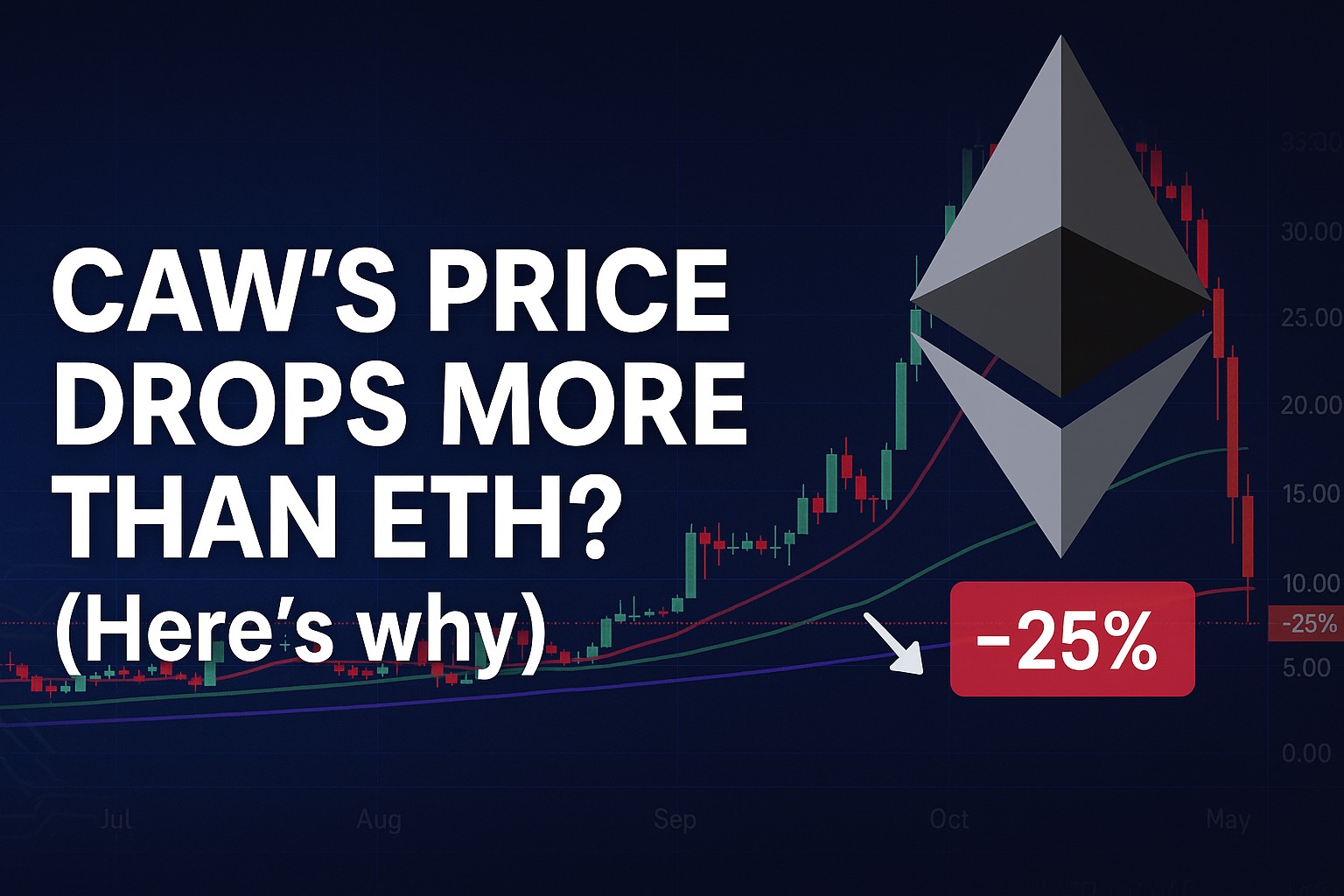
[Analysis] CAW’s Drop Is Not Abnormal — A Technical Look at Why It Happened
⸻
The Illusion of “CAW Dropping More Than ETH”
Recently, as Ethereum (ETH) fell, CAW’s price appeared to decline even more sharply.
This led some investors to worry about a potential whale sell-off.
However, in reality, this is a completely logical and expected effect based on how CAW’s price structure is built.
CAW currently trades in an ETH pairing on decentralized exchanges such as Uniswap.
This means its price in dollars is determined by multiplying its ETH ratio by Ethereum’s dollar value.
Even if no one sells CAW, if ETH itself loses value, the CAW/USD price automatically falls as well.
⸻
The Market Mechanism Behind It
Uniswap and similar decentralized exchanges use what’s called an Automated Market Maker (AMM) model, defined by a constant product formula:
x multiplied by y equals k.
Here, “x” represents the amount of CAW in the pool, “y” represents the amount of ETH, and “k” is a constant that keeps the total pool value balanced.
When ETH’s price decreases, the ETH side of the pool loses value in dollar terms.
To maintain balance, the algorithm automatically adjusts CAW’s price downward.
This happens even if no investor manually sells their CAW tokens.
In addition, arbitrage bots and automated rebalancing systems react instantly to market changes.
This often makes CAW’s price move faster or more sharply than ETH’s during sudden volatility.
⸻
Why CAW’s Drop Looks Exaggerated
Imagine ETH falling about ten percent in value.
CAW’s ratio to ETH may also decline slightly — perhaps another ten to fifteen percent — as the pool rebalances.
When those two effects combine, CAW’s total dollar value can easily appear twenty to twenty-five percent lower.
In other words, CAW’s sharper drop is not emotional selling, but a mathematical consequence of the AMM model and its pairing with ETH.
⸻
No Whale Selling — Just Market Mechanics
On-chain data from Etherscan confirms that the largest CAW holders have not changed their balances.
There is no sign of large-scale dumping or panic among top wallets.
However, CAW’s liquidity pool is still relatively small — around 900 ETH in size — so even small trades or automatic rebalances can move the market noticeably.
This is typical behavior for an early-stage token with limited liquidity: minor movements appear amplified.
⸻
Technically, This Is a Healthy Correction
Looking at indicators like RSI and MACD, CAW is currently sitting near oversold levels.
From a technical standpoint, this means the market could soon see a short-term rebound.
Historically, similar setups have occurred before major rallies.
When leveraged positions are wiped out, fear dominates, and large holders remain inactive —
that’s often when the next uptrend quietly begins.
⸻
A Calm Before the Next Phase
This decline should not be interpreted as a weakness in CAW itself.
It’s simply a reflection of Ethereum’s volatility and automated price rebalancing.
The project’s fundamentals remain unchanged, and large holders continue to sit tight.
In fact, this stage can be viewed as a reset: leverage has cleared, liquidity is stabilizing, and momentum indicators are approaching recovery zones.
CAW’s silence has always been strategic — and silence before movement often marks a turning point.
⸻
Final Thought
As Elon Musk might phrase it:
“When the crowd panics, the hunter moves.”
CAW’s design has always favored moments of silence, fear, and structural reset.
What we are witnessing now is not a collapse — it’s a recalibration before ignition.
Understanding the mechanics, not the emotions,
is what separates the holders from the hunters.
HODL!