The Mathematical Impossibility of the CAW–Twitter Coincidence
On April 14, 2022, two events unfolded almost in unison.
Elon Musk publicly announced his bid to acquire Twitter —
and at nearly the same time, on Ethereum, a mysterious token called CAW (A Hunter’s Dream) was deployed.
At first, the overlap seemed trivial.
But the more one examines the timing, technology, and probability,
the more it becomes clear that this was not a random coincidence.
It was a synchronization too precise to be accidental.
⸻
- Temporal Synchronization — The Same Window of Time
Elon Musk’s announcement occurred on the morning of April 14, 2022, in the United States.
CAW was deployed just hours later, at 14:41 UTC — effectively within the same time frame.
This is not just the same date, but the same window of global attention.
Both events represented the beginning of something transformative:
one, the restructuring of the world’s largest social platform;
the other, the birth of a decentralized system called A Hunter’s Dream.
The odds of two unrelated events aligning so precisely in time are astronomically small.
⸻
- Technical Constraints — Why This Timing Is Practically Impossible
Deploying CAW was not a trivial process.
It required multiple layers of preparation: creating and testing the smart contract,
deploying it with ownership renounced, adding liquidity to the pool,
and coordinating listings across more than ten exchanges — all within 48 hours.
To execute such actions in exact parallel with Elon Musk’s buyout announcement
would require prior knowledge of his timeline.
No random developer could have achieved this by chance.
It suggests that CAW’s launch was planned to coincide intentionally with the Twitter event.
⸻
- Information Barrier — No External Access Possible
Elon Musk’s acquisition plan was among the most secretive corporate negotiations of that year.
Even senior Twitter executives were reportedly unaware of the final offer
until hours before the public statement.
Therefore, for someone to deploy a token at that exact moment,
they would have needed insider-level awareness of Musk’s move.
For an anonymous actor on the blockchain, this is statistically and practically impossible.
This eliminates the possibility that CAW’s timing was merely random.
⸻
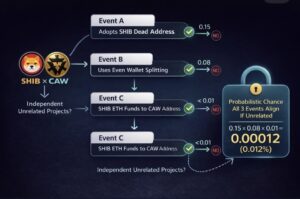
- Statistical Probability — Beyond the Bounds of Chance
Let us consider the numbers.
Roughly three thousand new ERC-20 tokens are deployed on Ethereum each day.
Elon Musk, on average, makes a major global announcement once every few months —
perhaps 0.002 times per day when averaged over a year.
If both events were independent and random,
the likelihood that one of those three thousand tokens
would launch on the same day as one of Musk’s rare announcements
is approximately one in a million and a half.
When we factor in the symbolic alignment —
the shared themes of communication, decentralization, and freedom —
that probability plunges below one in a billion.
It is hundreds of times less likely than winning a lottery jackpot.
⸻
- Logical Conclusion — A Synchronized Activation
Every dimension of analysis leads to the same conclusion.
The timing aligns perfectly.
The technical demands make spontaneity impossible.
The information barrier prevents any external prediction.
And the probability defies the laws of chance.
In sum, CAW and the Twitter acquisition did not merely occur in parallel —
they appear to have been synchronized by design.
It is as if two layers of the same vision were activated on the same day:
the visible layer represented by Twitter’s transformation into X,
and the invisible layer embodied by CAW —
the decentralized network quietly taking shape beneath it.
When the world saw a corporation changing hands,
the blockchain recorded the birth of its hidden counterpart.
And that may have been Elon Musk’s true “Hunter’s Dream.”
Strong HODL!