CAW Is NOT a Scam: 6 On-Chain Facts That Prove It
⸻
- Irreversible Smart Contract Architecture
CAW’s Ethereum smart contract is fully verified and open-source on Etherscan. Every function, variable, and transaction since deployment can be examined by anyone, anytime.
After launch, the deployer renounced ownership, permanently removing all administrative privileges—meaning there is no way to change the rules, mint new tokens, or add hidden fees later.
There are no backdoor functions to block transfers, freeze wallets, or manipulate liquidity. The code is minimal, immutable, and mirrors the “set it and let it run” philosophy of Bitcoin.
⸻
- Reverse-Incentive Token Flow
From day one, CAW’s deployer acted in direct opposition to typical rug-pull behavior. Instead of hoarding tokens to dump later, the deployer burned 124.6 billion CAW from their own holdings, contributing to a total of roughly 30 trillion CAW burned—about 4.5% of the total supply.
The initial distribution was market-driven through public liquidity pools rather than centralized allocations. On-chain analysis also shows that the largest holders have been dormant for long periods, signaling low active sell pressure.
⸻
- Absence of Centralized Control
CAW’s code is fixed and non-upgradeable, with no “proxy” pattern that could allow silent changes in the future.
There was no ICO, IDO, presale, or investment round—no investor promises, no “send ETH and we’ll send you tokens later” scheme.
Price discovery happens in public order books on decentralized and select centralized exchanges. There’s no internal market-making desk that can manipulate spreads behind closed doors.
⸻
- A Philosophical Protocol, Not a Speculative Roadmap
Unlike most tokens that sell a future vision with ROI charts, price predictions, and aggressive marketing, CAW’s “whitepaper” is a set of poems, cryptic phrases, and philosophical statements.
Its governance model is DAO-less, encoded entirely into the contract—once deployed, it requires no leaders, no voting, and no treasury.
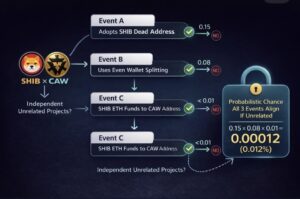
This is strikingly similar to the ideological stance of Ryoshi, the anonymous creator of Shiba Inu, who advocated for founders to disappear and for projects to live only through code and community.
⸻
- LayerZero Interoperability
CAW is officially registered as an Omnichain Fungible Token (OFT) in the LayerZero protocol. This allows it to move seamlessly between blockchains, enabling cross-chain liquidity and integration into multiple ecosystems.
Scam tokens are almost always isolated to a single chain with no bridge support, ensuring victims can’t exit. CAW is the opposite—designed for portability, not entrapment.
⸻
- Full On-Chain Transparency
Every single CAW burn, transfer, liquidity event, and large holder movement is recorded on Ethereum’s public ledger, available for anyone to verify.
Advanced analytics tools like Nansen, Arkham Intelligence, and Glassnode can track its entire token flow in real time.
This transforms trust from “believe the team” into “verify the blockchain.” If a project’s integrity can be confirmed independently, it moves far outside the classic scam profile.
⸻
Conclusion
Technically and structurally, CAW is built in a way that makes scam-style behavior nearly impossible:
•Immutable, renounced smart contract
•Significant self-burns reducing sell-side liquidity
•No centralized treasury or hidden control mechanisms
•Philosophy-driven, leaderless governance
•Cross-chain operability via LayerZero
•100% verifiable, transparent on-chain history
Instead of a short-lived pump-and-dump, CAW operates like a decentralized experiment in trustless value storage—more in line with Bitcoin’s ethos than with the typical “get rich quick” schemes of the crypto world.
HODL!